I’ve always felt a quiet appreciation for West African culture. Growing up, some of my Ghanaian and Nigerian friends generously invited me into their traditions, through mainly food and music. I must assume that these early encounters with such cultures left me with an enduring sense of curiosity and admiration, although it laid dormant for many years as my focuses were redirected in the chaos that is secondary school and sixth form. Recently, that spark was reignited at university through personal studies. What began as a casual appreciation for modern West African architecture, particularly in Ghana, has now grown into a deeper academic interest and the focus of my third-year dissertation.
As my dissertation research began to take shape, it became clear that I needed to experience Ghana first-hand. I entered the trip with a degree of scepticism, especially toward the idea of volunteering abroad, which can often feel performative or extractive. Instead, I chose to treat volunteering as a tool for observation and a way of grounding myself within the everyday rhythms of a place, while remaining conscious that I was stepping into someone else’s culture. This awareness of myself as the potentially controversial ‘voluntourist’ would remain with me throughout the trip. This perspective would shape how I’d engage with the trip and ultimately guided my dissertation toward exploring how colonial-rooted systems and architecture continue to persist in Ghana today.
All of these thoughts were swirling in my head as I set off from the airport. After a brief layover in Morocco and an embarrassingly poor attempt at ordering tea in French, I was finally on the plane to Ghana. After landing, I was picked up and taken to the homestay in Accra where I would stay until my program began. There I met with three other solo travellers, and we quickly decided we wanted to do some exploring. The next day, after three or four hours on some famously bumpy roads, we arrived in Cape Coast. This was my first real experience in a Ghanaian city, as I’d only really been sleeping and passing through in Accra. Cape Coast felt immediately different: the buildings were lower than those in Accra, but the city itself was somehow louder, more animated. Our first stop was Cape Coast Castle, which still, in many ways, dominates the city’s identity. Our guide was excellent, and the way he told the stories of those who were imprisoned and sold there not so long ago was powerful and deeply moving. At the end of the tour there is this beautiful moment where we all got to walk out and return through the Door of No Return. In the beaches beyond the Door, waters that once held colonial ships are scattered with the vibrant traditional Ghanaian fishing boats.
That evening, back at our guesthouse, we shared drinks and a long conversation while a festival filled the streets below us with music from a brass band. The following day we set off again, this time to Kakum National Park, where we braved the canopy walk high above the rainforest and, later, even found ourselves petting crocodiles – an experience that was equal parts terrifying and surreal. With a little more time left in Cape Coast, we made one more stop: Elmina Castle. Smaller than Cape Coast Castle but just as powerful, it carried a similar weight of history in its walls and dungeons. It was impossible not to feel the echoes of what had happened there and, together with Cape Coast, it left a lasting impression on how deeply the scars of colonialism remain embedded in place.
After Cape Coast, I finally made my way to the volunteer house, about two hours north of Accra. The drive was cramped and hot, and by the time we arrived I was ready to stretch my legs. As soon as we stepped into the compound, children who had been playing outside came running over, excited to meet the new obronis (the Twi word for foreigner). The other volunteers showed us around and we spent that first evening getting to know each other, playing cards under the dim lights and drinking fresh coconuts straight from the trees outside.
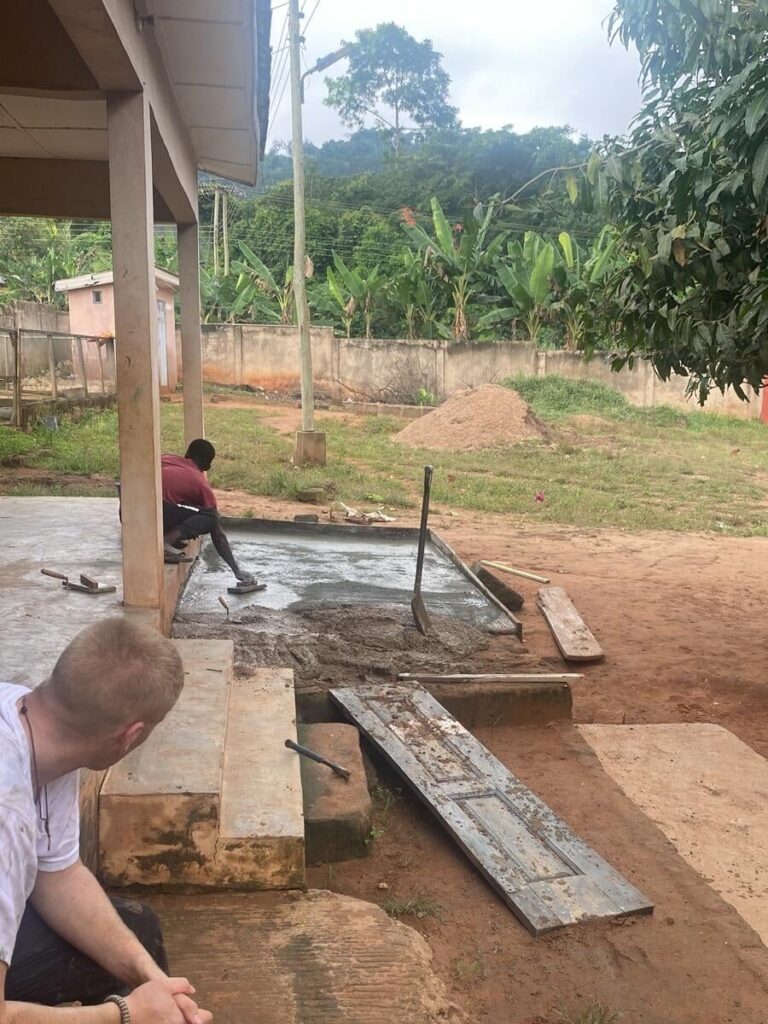
Our first week of work was tough. The days were hot, the labour was heavy, and everything was done by hand. We spent our time helping to build and preserve a school in the village, laying bricks and mixing mortar. When we ran out of bricks, we pressed more ourselves from sand and cement. It felt raw but also strikingly responsive to the needs of the community. That week, for example, the children asked for a second veranda beside their playground, so we set to work laying the foundations. The experience was exhausting but rewarding, and it also gave me a glimpse of how building practices adapt directly to context.
Mid-week, after one particularly messy shift (and a long scrub to get the cement off my skin), we caught a trotro into the nearby town of Koforidua. Unlike Cape Coast, it felt more like a working city, with its market focused on fresh produce and fabrics rather than tourism. The fabric stalls mesmerised me and we spent ages winding our way through the narrow, dim corridors just to see every pattern and colour. On the way back I stopped at a local seamstress, who, with effortless skill, made me a skirt within a day that fit me perfectly.
Our second week of work was on the volunteer compound itself. We spent our days laying a concrete foundation that would become a gathering space for the community and repairing the floors of the existing verandas. It was heavy, repetitive work under the sun, but there was something satisfying about seeing the space slowly transform into somewhere more usable and welcoming.
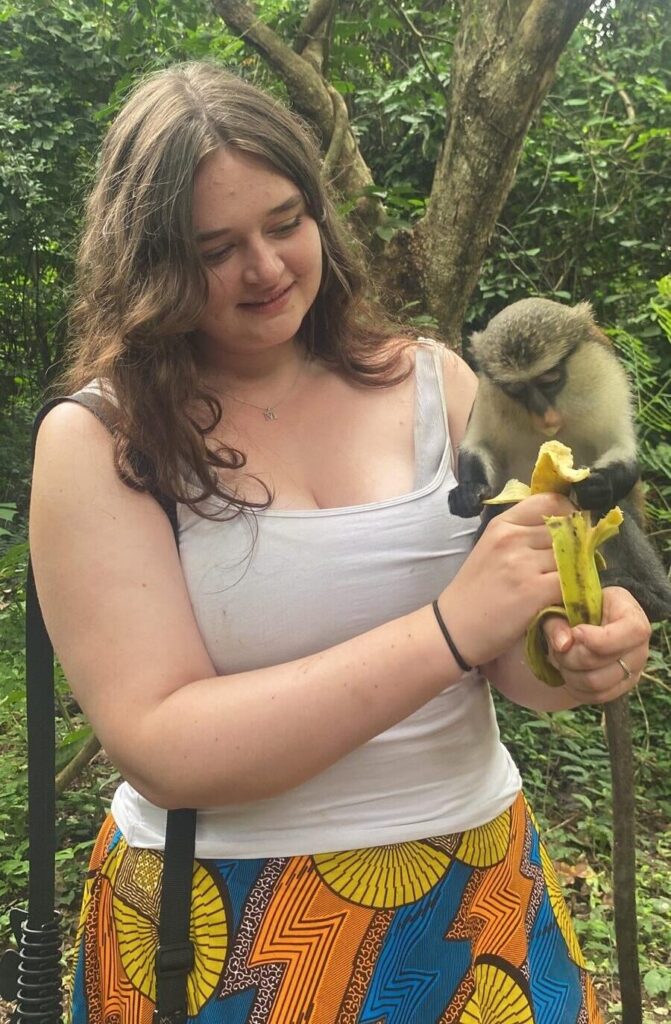
That weekend, our group ventured east to the border with Togo to visit the Wli Waterfalls – the tallest waterfalls in West Africa. After hiking through the rainforest, we reached the base and went swimming beneath the falls. The water crashed down with such force that facing it filled your eyes with a thick mist if you were too close. Driving and hiking through the Agumatsa mountain range to get there felt surreal: steep hills alive with vibrant colours, red and orange earth, and unfamiliar birdsong that made the whole landscape feel otherworldly. On the way back we stopped at a sacred forest that is home to a monkey sanctuary, where we fed and held Mona monkeys. I’ve always loved monkeys, so having them clamber onto my arms for food was a dream come true.
My final week of work focused on finishing what we had started. We pressed and placed more bricks and completed the veranda, adding staircases around its edges so the children could descend from it safely. Returning to projects we’d begun earlier and seeing them through to completion was incredibly rewarding and I realised that not every volunteer gets to witness that stage, depending on how long they stay. This last week was also the hardest, as I had begun to bond deeply with people in the village. One Sunday, I joined them for church. I’m not religious, but it was a moving experience: the whole community gathered together in music and spirit was beautiful to witness, and I felt grateful to be welcomed into it, even briefly. As the days wound down, I became unexpectedly emotional, taking photos of the spaces and people I knew I would soon miss.
It was with all of this in mind that I left the village and made my way to Accra for my final stop, ready to explore the capital properly. I explored Accra solo, which terrified me at first, but by then I felt acclimatised to the culture and was honestly looking forward to a bit of freedom. It was in the capital that I managed to tick off most of my architectural must-sees: the W.E.B. Du Bois Centre, the National Museum of Ghana, and the Kwame Nkrumah Memorial Park and Mausoleum. Each site was astonishing; introducing me to architectural styles and approaches I had never encountered before. It was also in Accra that I had the chance to speak to a few locals and gather some more perspectives for my dissertation research, which helped me see these spaces not only as monuments but as living parts of the city’s identity. The people of Accra were incredibly welcoming, and I don’t think I had a single bad tour guide: everyone I met was spirited, knowledgeable, and proud to share their history.
For my final souvenirs and also a quick meal, I wandered through Makola Market, one of the largest in West Africa. It was a sensory whirlwind: fragrant with spices, bursting with colourful fabrics and fresh produce, at once bustling and carefully organised. After such an amazing trip, it was suddenly time to head home.
In the end, this trip felt like closing a circle. What began as a quiet appreciation for West African culture through the food and music of my friends has now become something much deeper. Ghana gave me memories of landscapes, buildings, and people that I’ll never forget, and it turned my research into something lived rather than just studied. I left with souvenirs in my bag, but more importantly with a stronger sense of connection to a culture I’d admired from afar for so long.